NBFC REGISTRATION IN INDIA
NBFC registration can be obtained by complying with the provisions of the Companies Act, 2013.
NBFC registration can be obtained by complying with the provisions of the Companies Act, 2013.

Company registration, bank account opening, and business plan drafting.

Capital infusion and preparation of all RBI-required documents.

RBI scrutiny, clarifications, and issuance of Certificate of Registration.
To start a non-banking financial services business in India, obtaining NBFC registration from the Reserve Bank of India (RBI) is mandatory. NBFCs do not require a banking license but are regulated by the RBI under Chapter III-B of the Reserve Bank of India Act, 1934.
Only companies incorporated under the Companies Act, 2013, can apply for NBFC registration. As per Section 45-IA of the RBI Act, a company must obtain a Certificate of Registration (CoR) and meet the prescribed Net Owned Fund (NOF) requirement, which is currently ₹10 crore for most NBFCs.
NBFCs play an important role in the financial system by providing loans, investments, and other financial services, particularly where banks have limited reach. While some NBFCs may accept deposits with RBI approval, they cannot accept demand deposits, and such deposits are not covered under deposit insurance.
NBFC, which stands for Non-Banking Financial Company (NBFC) is a company registered under the Companies Act, 1956 or Companies Act, 2013 engaged in the business of loans and advances, acquisition of shares or stocks or bonds or debentures or securities issued by the Government or local authority or other marketable securities of a like nature, leasing, hire purchase etc. as their principal business but does not include any institution whose principal business is that of agriculture activity, industrial activity, purchase or sale of any goods (other than securities) or providing any services and sale/purchase/construction of immovable property.
Additionally, an NBFC company whose principal business is receiving deposits under any scheme or arrangement in one lump sum or in instalments by way of contributions or in any manner is also a non-banking financial company (Residuary non-banking company).

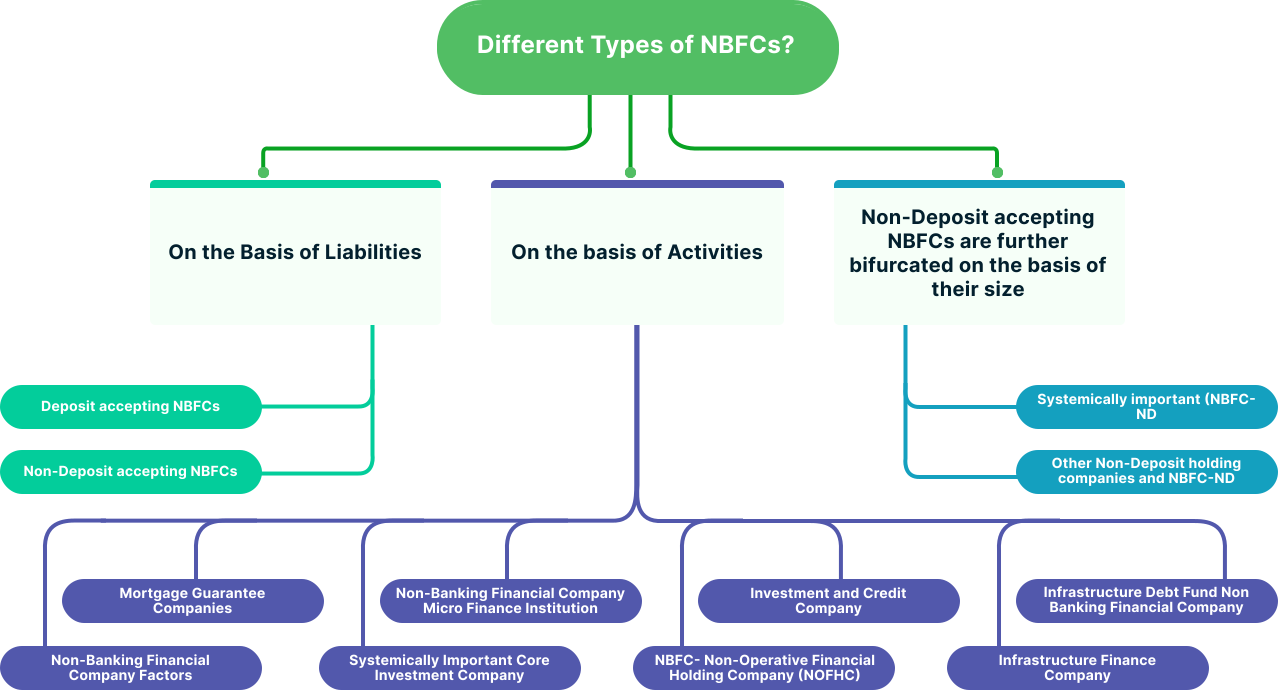
Non-deposit NBFCs with assets below ₹1,000 crore.

Deposit-taking and larger NBFCs with higher compliance.

Top NBFCs identified by RBI based on size and risk.

Special category for NBFCs posing systemic risk.
The preconditions for NBFC Registration in India are as follows:
The list of activities that don’t need NBFC registration is as follows:








The difference between NBFC and Bank is as follows:
| Criteria For Comparison | Non-banking Financial Corporation | Banks |
|---|---|---|
| Regulation | Regulated by RBI Act | Banking Regulation Act, 1949 |
| Demand deposits | Not allowed | Allowed |
| Cheque | Cannot issue cheques | Can issue cheques and payment systems |
| Deposit Insurance Facility | Not available | Available (DIGGC) |
| Lending | Limited lending scope | Broad lending scope |
| Payment Systems | Cannot participate in payment systems | Can participate (e.g. NEFT, RTGS) |
| Risk Profile | Generally higher risk exposure | Lower risk profile |
| Liquidity Access | Limited | Access to Central Bank liquidity support (RBI) |
| Foreign Direct Investment | Up to 100% (Automatic Route) | Private Banks Up to 74% (with conditions), Public Banks capped at 20% |
The significant benefits of NBFC registration in India are as follows:
The powers of RBI on NBFC banks in India are:
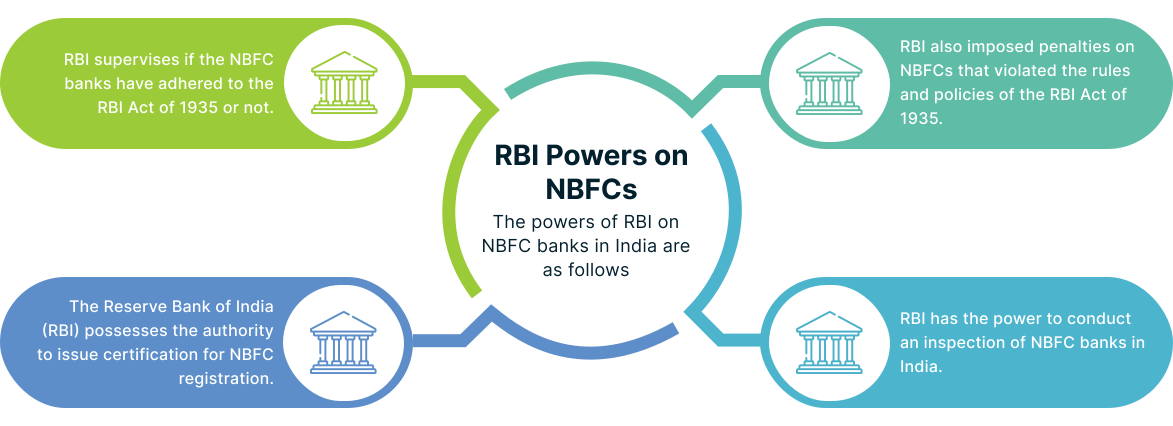
The major financial institutions directly overseen by the Reserve Bank of India (RBI) are mentioned below-


The list of requirements for documents for NBFC license and penalties is as follows:
The documents needed to register NBFC in India are mentioned below-
Given below are the penalties applicable under RBI regulations for NBFC registration in India-
The list of compliance requirements for NBFC license registration is as follows:
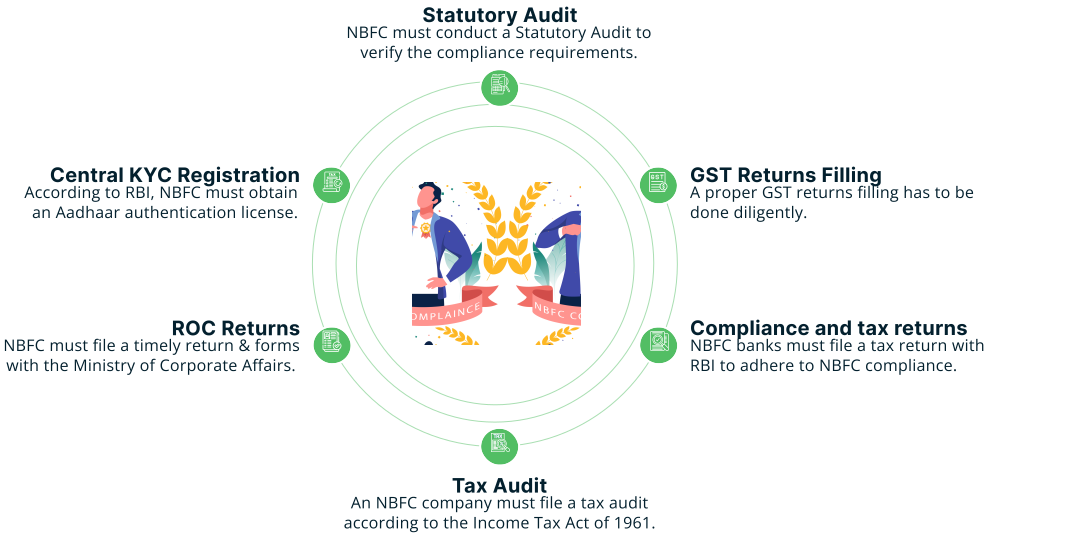
The step-by-step procedure of NBFC registration online is as follows:



Mandatory registration with Credit Information Companies to report credit data.


Registration with the Financial Intelligence Unit to monitor and prevent money laundering activities.


Submission of client details to the Central Registry of Securitisation Asset Reconstruction and Security Interest.
Implementation of RBI’s Fair Practice Code for transparent customer dealings.
Regular Anti-Money Laundering/Combating Financing of Terrorism training for staff.
Board-approved policy covering operational, credit, and market risk management.
Regular submission of statutory returns (DNBS01, DNBS02, DNBS03, DNBS04A, DNBS04B, DNBS06, DNBS10).
Quarterly submission of Form A to certify compliance with registration conditions.
Maintenance of prescribed financial ratios such as CRAR, LCR, and Leverage Ratio.
The list of post-compliance for NBFC license from RBI is as follows:
Have a look at the NBFC registration compliance checklist-
The demand for NBFC registration is sky-high among NBFC business enthusiasts. The market trends and projections below suggest a strong and positive future for the digital lending ecosystem.
RBI may cancel the application for NBFC registration for the following reasons:

If the NBFC applicant fails to maintain the mandatory minimum Net Owned Fund (NOF) as prescribed by the RBI.

If the NBFC fails to conduct its business in a manner that serves the public interest.

If the NBFC, in case of a deposit-taking entity, fails to repay deposits according to the terms agreed with depositors.

If the NBFC fails to commence or carry out its primary financial business.

If the NBFC fails to maintain or submit proper books of accounts in accordance with RBI guidelines.

If the Directors of the applicant do not meet RBI’s “fit and proper” criteria.

If the applicant fails to present a viable and structured business plan acceptable to RBI.

If the shareholders’ profiles, ownership details, or source of funds are not transparent or verifiable.
Following are the reasons why one should choose Registernbfc for NBFC Registration

NBFC Clients

Fresh NBFC Registration

Team of CA, CS, Ex-Banker

Cities Served

Customer Service

Customer Score

SLA Delivery